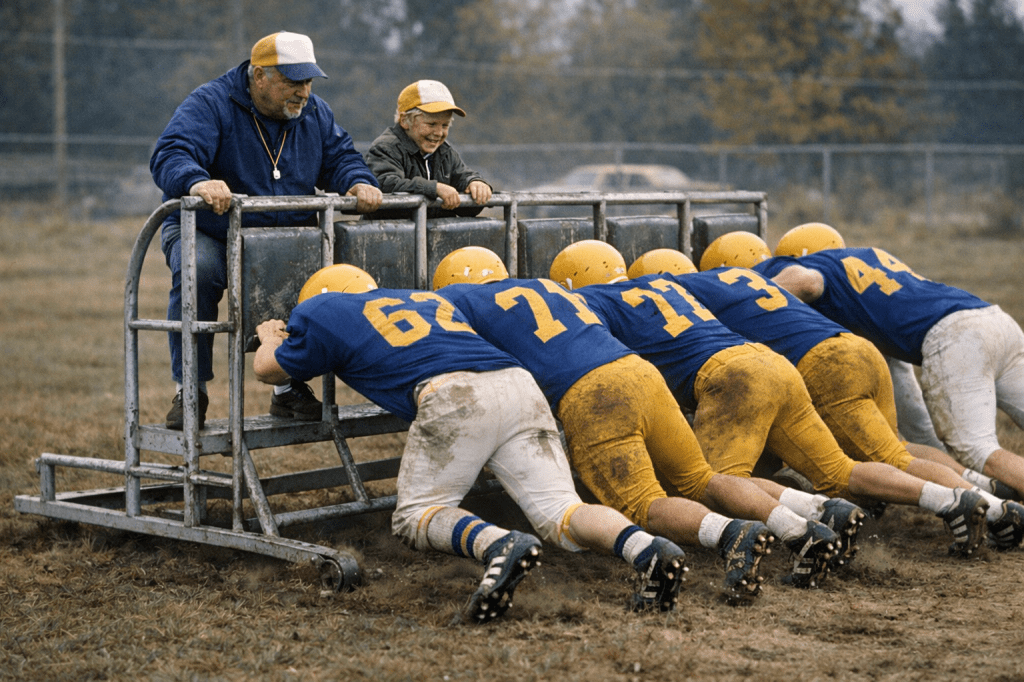
There’s a hill above a small-town football field.
Second tier.
That’s where the brown station wagon would park on Friday nights.
1970s brown. Long. Heavy doors.
More room than car.
Down below, my dad was the head coach.
At that age, he might as well have been invisible to me — not emotionally, just physically.
I didn’t see him.
I didn’t interact with him.
I only knew that being there mattered.
Inside the station wagon, my mom engineered warmth.
Super-hot hot chocolate sealed inside a fragile glass thermos.
You weren’t allowed to drink from it directly.
You could only drink from the red plastic cup that screwed onto the top.
It was always too hot.
The first sip would singe my tongue every time.
Not enough to hurt — just enough to announce itself.
Steam rising. Hands cold. Tongue burning.
I’d blow on it, knowing it wouldn’t help, and sip anyway.
A big brown paper sack of popcorn sat nearby,
butter soaking through, oil stains spreading like quiet maps of care.
The back of the wagon was layered with sleeping bags.
Cocoons stacked on cocoons.
But bodies make moisture, and moisture fogs windows, and fog wasn’t acceptable.
So sometimes I was sent out.
Not as punishment.
Just physics.
The cold had texture.
Aluminum bleachers that pulled heat straight out of you.
Later in the season, flurries would drift down — light, indifferent.
The field would turn white, then slush, then mud.
I had zero interest in football.
The noise. The rules. The obsession.
It all felt loud in a way my nervous system couldn’t translate.
When something good happened in the game,
people would honk their car horns from the hill or the road below.
Long bursts — a rough symphony of horns.
Approval translated into sound,
as if the whole town needed to announce agreement with what had just occurred.
The honking would cut through the cold air,
bounce off the bleachers,
and then disappear until the next touchdown.
On the opposite side of the field, under the bleachers, was the radio announcer booth.
Built up between two light poles.
A wooden ladder led to it.
A hatch underneath.
I was never allowed up there.
It was sacred space.
Adult space.
Important space.
I got to peek once.
Inside, there was nothing mystical —
just bare wooden shelves holding radio equipment.
Structure and function pretending to be special
because of where it sat.
One night, the game got so intense a radio announcer had a heart attack up there.
He didn’t survive.
Dad said it was very hard to get him out.
That stayed with me.
If I had to be out there, I stayed low.
Away from the crowd.
Letting the cold be even, predictable.
I’d watch younger kids throwing footballs, rehearsing a future they wanted.
That ball — that awkward shape — never made sense to my hands.
Coordination and autism don’t always negotiate well.
Autism does something else, though.
It doesn’t let memories fade politely.
It keeps them close.
This doesn’t feel like a lifetime ago.
It feels like a few days ago.
I can still hear the honking when something went right.
Still feel the burn of the red cup on my tongue.
Still see the fogged windows and the snow falling past the bright light poles.
Still know exactly what it felt like to be sent out of the warm.
Eventually, I’d beg to go back to the station wagon.
Back to the sleeping bags.
Back to fogged windows, quiet warmth,
and the smell of popcorn and care.
I wanted to be home.
But we stayed.
Because support, I learned early,
doesn’t always look like excitement.
Sometimes it looks like sitting in the cold,
while approval honks in the distance,
remembering everything exactly as it was,
and carrying peace quietly
while someone you love lives inside a world
that was never meant for you.
 Oddly Robbie
Leave a comment