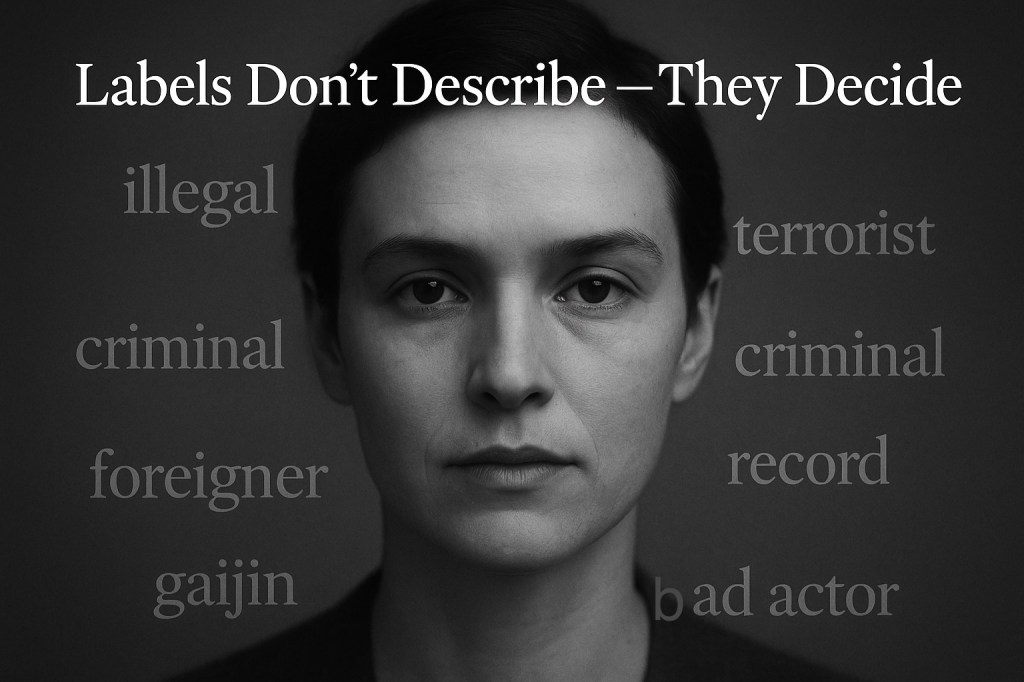
I’ve lived on both sides of labels.
I had a strong connection with an Argentinian community in the US.
In the United States, some people aren’t just called foreign. Some are called alien.
Sometimes some are even called “illegal.”
Which is not just cruel — it’s poor English.
Illegal is an adjective.
You can’t be illegal.
Actions can violate laws. People cannot.
But language doesn’t care about grammar when it’s being used to simplify humans.
⸻
Now I live outside the United States.
I’m the foreigner.
In Spain, I’m sometimes called a guiri. That word doesn’t sting. It loosely groups me with people from the north — Scandinavian, Germanic — which, looking the way I do, makes sense. It describes where I’m from, not what I am.
Some labels describe.
Others decide.
⸻
When a word becomes a life sentence
There’s a difference between language that points to behavior
and language that freezes identity.
Calling someone a terrorist doesn’t describe what they did. It declares what they are — permanently. Even if they stop. Even if they change. Even if they spend the rest of their life doing something else entirely.
The label stays.
The same is true for people with criminal records. A person with a record will always be a person with a record unless the system itself changes. Not because people can’t grow. But because systems are designed to remember without context. Records don’t track who someone has become. They freeze who someone once was.
Society says:
• Pay your debt.
• Rehabilitate.
• Do better.
But the system quietly replies:
• You are still this.
That contradiction isn’t accidental.
⸻
Why systems love labels
Labels are efficient.
They remove the need to ask:
• What happened?
• Why did it happen?
• Has anything changed?
Once a label is applied:
• curiosity feels dangerous
• empathy looks like weakness
• context sounds like justification
A labeled person becomes manageable.
Predictable.
Sortable.
Dismissible.
And most importantly — unchanging.
⸻
Japan taught me this gently
I fell in love with Japan. The language. The precision. The unspoken agreements. But I always knew one thing:
I would always be gaijin. 外人 — gai-jin Outside person.
I could study. I could speak Japanese well. But if my Japanese ever became too perfect — if I sounded native — it would unsettle people. Because I wasn’t in the role.
In Japan, language doesn’t just communicate meaning. It signals where you belong. A foreigner who speaks Japanese well is admired. A foreigner who sounds Japanese breaks the social map. And I understood that. I would never be fully inside the culture — not because I wasn’t welcome, but because belonging isn’t granted by fluency alone. That realization wasn’t bitter. It was clarifying.
Sometimes respect means knowing where you stand — and standing there honestly.
⸻
The danger of “good people” and “bad people”
We love moral shortcuts.
Good person.
Bad person.
But those labels are traps. If someone is bad, change becomes unlikely. If someone is good, their harm gets excused.
Reality is messier — and more hopeful.
People who often act kindly can still cause harm.
People who have caused harm can still choose differently.
Humans are not states of being.
We are patterns of behavior.
And patterns can change — if language allows them to.
⸻
Why this matters now Words aren’t neutral. They shape policy. They shape justice. They shape who we believe is allowed a future. When language turns actions into identity, it quietly removes the exits. And when there’s no way back into humanity, systems stop needing to imagine repair — only containment.
⸻
A different way to speak
What if we described behavior instead of declaring identity?
• harmful action, not bad person
• undocumented person, not illegal
• unsafe behavior, not enemy
• past conviction, not permanent criminal
These words don’t excuse harm.
They locate it accurately.
And accuracy matters — because it leaves room for accountability and change.
⸻
Labels don’t describe. They decide. They decide who gets a future. They decide who remains frozen in the past.
People are always more than the worst — or best — thing they’ve ever done.
And any system that forgets that
eventually forgets how to be human.
P.S.
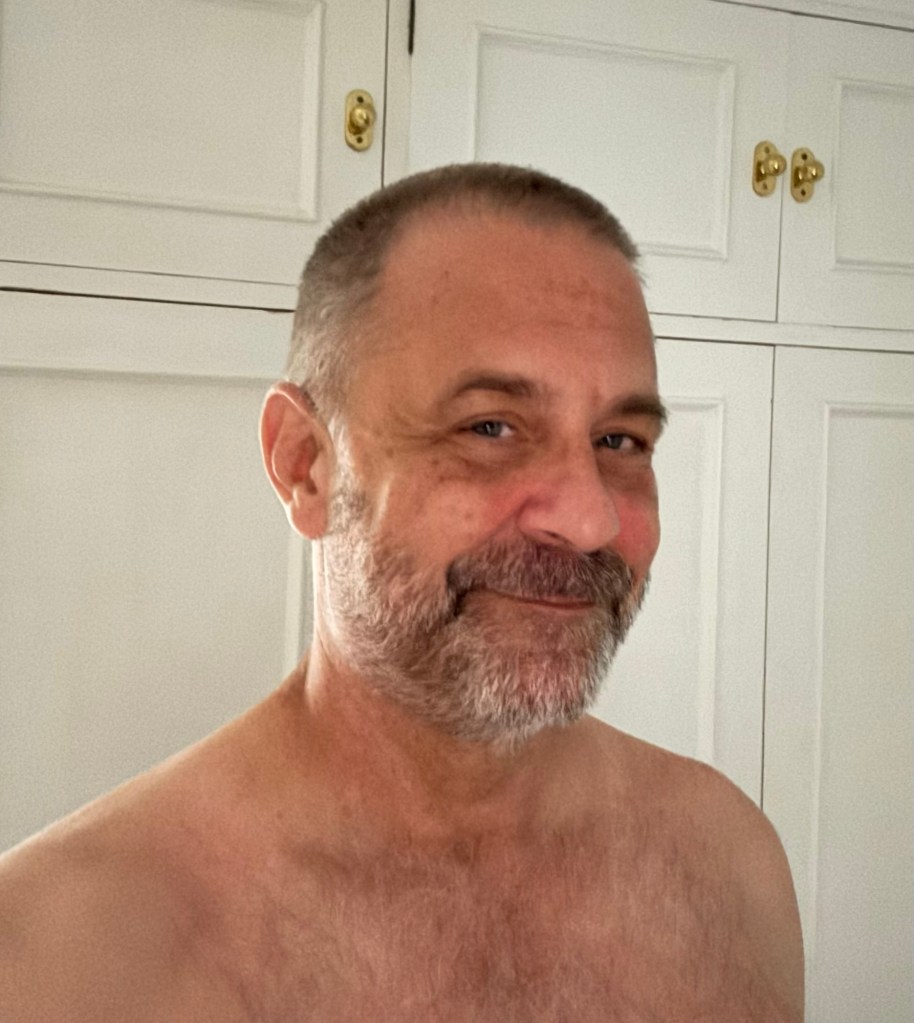
I’m not hiding, and I wouldn’t change who I am.
I chose my avatar as a younger version of myself for practical reasons — it let the work move freely without copyright friction around my real image.
OddlyRobbie is the work. I’m the human behind it.
 Oddly Robbie
Leave a comment