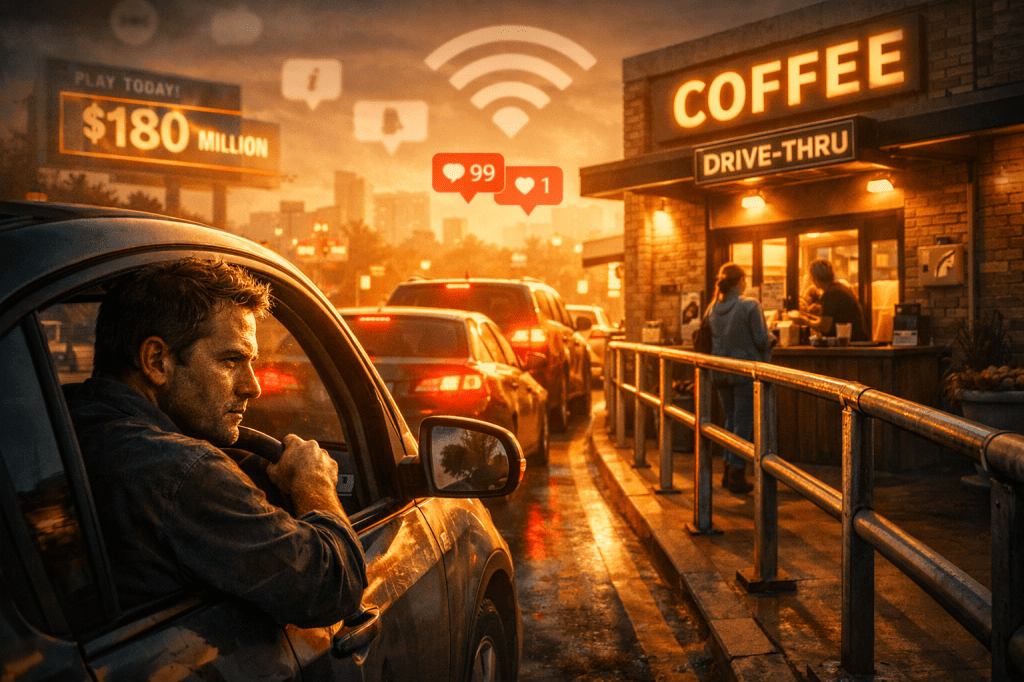
It began with coffee. Not ideology. Not politics. Not outrage. Just a simple moment: I needed a coffee — and I couldn’t get one.
The usual rhythm didn’t happen. The places I go were packed. My head hurt. I felt irritable, almost angry, and for a brief moment I didn’t like who I was becoming. Not because of people — but because my nervous system felt cornered.
That’s when something clicked.
When I finally took a sip of yerba mate, my system snapped back to baseline instantly. Clean. Fast. Too fast. It felt less like comfort and more like a switch being thrown.
And suddenly I saw it. This is what’s happening everywhere. Our nervous systems are being hijacked — not by villains, but by design.
Sugar plus caffeine.
Swipe plus click.
Rage plus repetition.
Different surfaces, same mechanism: bypass natural regulation and replace it with external control.
People aren’t weak. They’re overstimulated.
Then I thought about the lottery.
“Things could get better — right now.”
“Everything could change — instantly.”
The odds don’t matter. The possibility does. That’s the paradox. The lottery doesn’t sell money. It sells relief from the present. A brief chemical lift of hope. A moment where the future feels lighter. A promise that endurance will be rewarded — not through agency, but through luck.
And like every hijack, it teaches the body something quietly dangerous:
Endure now. Salvation comes from outside you.
Then I noticed something even more literal. Some fast-food and coffee drive-throughs have rails. Once you enter, you’re committed. You can’t step out of line. You can’t change your mind. You can’t leave — not without disrupting everyone behind you. Cars idle. Engines run. Ahead of you: the promise. Behind you: pressure. Around you: barriers. It’s a small thing — just metal rails in a parking lot — but it says everything.
A system designed so backing out isn’t easy. A system that assumes compliance once desire is activated. A system where stopping feels harder than continuing.
You’re not just waiting for coffee. You’re participating in a structure that doesn’t expect reconsideration. And suddenly it isn’t just about caffeine. It’s about how often our lives are arranged so that once we step in, momentum replaces choice.
Television ads do the same thing, just more softly. They don’t ask what we need. They construct it.
You’re not enough — until this.
You’re tired — until that.
You’re behind — until now.
Music sets the emotional key. Faces model desire. Repetition does the work. It isn’t persuasion anymore. It’s conditioning.
Coffee lines stretch around blocks. Cars idle. Feeds refresh endlessly. Energy drinks replace sleep. Rage replaces meaning. Commercials replace reflection.
A few systems get very rich. Millions of nervous systems pay the price.
What struck me most wasn’t judgment — it was recognition.
Once you feel how fast chemistry and suggestion can override agency, you can’t unsee it. Not in energy drinks. Not in swipe-based hope. Not in outrage networks. Not in lanes designed with no exits.
This isn’t about banning coffee, deleting apps, or turning off the TV forever. It’s about noticing when something stops being optional.
The moment that mattered wasn’t needing caffeine. It was losing myself, briefly, when I didn’t have it.
That’s the line.
If something bypasses choice, it isn’t neutral. And the good news is this: awareness restores agency.
The moment I saw it, the grip loosened.
Not through force — but through clarity.
Sometimes seeing the system is enough to step out of it.
 Oddly Robbie
Leave a comment